
The purpose of eNSEMBLE (Future of Digital Collaboration) is to fundamentally redefine digital tools for collaboration. The pandemic has demonstrated both the possibilities and limitations of current tools for computer-mediated collaboration. Whether it is to reduce our travel, to better mesh the territory and society, or to face the forthcoming problems and transformations of the next decades, the challenges of the 21st century will require us to collaborate at an unprecedented speed and scale.
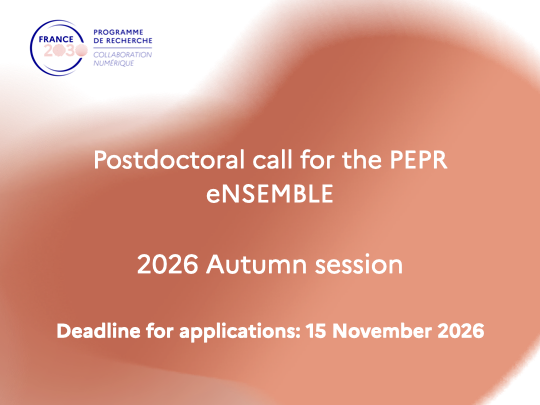
The PEPR eNSEMBLE launches a postdoctoral call to promising young researchers to participate in this collaborative endeavour.
The laureates will have a post-doctoral contract from 12 to 24 months (at the same salary as for similar contracts in the recruiting institution) as well as 10K€ of support for the purchase of equipment and travel expenses.
Eligibility
- The applicant must hold a doctoral degree at the beginning of the contract.
- The host laboratory and the referent advisor must be part of one of the partner institutions. The list of partner institutions depends on the “targeted project” (PC for “Projet Ciblé”) of PEPR eNSEMBLE and are available in the application form (and below). This partner will be the recipient of the funding.
- CNRS (PC1, PC2, PC3, PC4, PC5) – all UMR
- École Nationale Supérieure d’Arts et Métiers (ENSAM) (PC1, PC2, PC3, PC4, PC5)
- Inria (PC1, PC2, PC3, PC4, PC5) – all EP
- Institut Mines-Télécom (IMT) (PC1, PC2, PC3, PC4, PC5) – all members
- Sorbonne Université (PC1, PC2, PC3, PC4, PC5)
- Université Claude Bernard – Lyon 1 (PC1, PC2, PC3, PC4, PC5)
- Université Grenoble-Alpes (PC1, PC2, PC3, PC4, PC5)
- Université Paris-Saclay (PC1, PC2, PC3, PC4, PC5)
- Université de Toulouse (Paul Sabatier) (PC1, PC2, PC3, PC4, PC5)
- École Nationale de l’Aviation Civile (ENAC) (PC1, PC3, PC4, PC5)
- Université de Lille (PC1, PC2, PC3, PC4)
- Université de Technologie de Troyes (UTT) (PC2, PC3, PC4, PC5)
- CESI (PC1, PC3, PC5)
- Université Gustave Eiffel (PC1, PC3, PC5)
- Grenoble INP (PC1, PC3)
- Université de La Réunion (PC4, PC5)
- Université de Lorraine (PC1, PC3)
- Université de Rouen Normandie (PC4, PC5)
- Université de Strasbourg (PC1, PC5)
- Université de Technologie de Compiègne (UTC) (PC4, PC5)
- INSA Lyon (PC2)
- Institut d’Études Politiques de Grenoble (IEPG) (PC4)
- Nantes Université (PC2)
- Université Paris 1 Panthéon-Sorbonne (PC5)
- Université d’Évry (PC1)
- Université de Rennes (PC5)
- The research program should be aligned with at least the objectives of one the five PCs: PC1 CATS, PC2 PILOT, PC3 MATCHING,
PC4 CONGRATS, PC5 TRANSVERSE (please note: the Targeted Project 4 (PC4 CONGRATS) will not open postdoctoral positions for the 2026 autumn session. Thank you for your understanding). - The postdoctoral contract should start no later than 6 months after the interview date.
Process
The co-chairs of the targeted project (PC) will analyse the submitted applications and select the candidates invited for an interview.
The selected candidates will then give an oral presentation to present (1) their CV, (2) their previous research, (3) the proposed research program and (4) the adequacy of the research program to the PEPR eNSEMBLE and the selected PC. The jury will be composed of at least two co-chairs of the selected PC and one program director of eNSEMBLE. The interview will take place by videoconference.
Submission form
Use this form to submit your application. Although the form is in English, you can answer the questions and upload your documents in either English or French.
The application form requires uploading several PDF documents including:
- CV of the candidate (2 pages maximum)
- CV of the main advisor (2 pages maximum)
- Research program (3 pages maximum) including:
- Context, Objectives, Challenges, Approach, Originality, Methods, Anticipated results,
- Project organisation (feasibility, duration, milestones, partnerships, etc.)
- Adequacy with the objectives of PEPR eNSEMBLE and of the selected PC.
Selection criteria
- Quality of the CV of the candidate
- Quality of the research program (objective, approach, originality, methods, feasability)
- Adequacy of the research program with (1) the PEPR eNSEMBLE objectives and (2) the specific topics of the selected PC (see details & additional requirements for some PCs in the application form)
- Commitment to participate in PEPR eNSEMBLE, including the animation of the selected PC
The final decision takes into account program-wide criteria such as an equitable sharing of financial resources across space (geographical distribution), time (from one year to the next), partner institutions, etc.
The potential of the proposed topic to connect with existing work within the PEPR eNSEMBLE programme, i.e. the potential for the topic to build upon, contribute to or link with work (theses and postdoctoral research) that has already begun, will also be taken into account, although this is not a prerequisite for applying.
The weight of the different criteria might depend on the selected PCs. We invite the candidate to carefully read the description of the selected PC and contact the PC chairs ahead of their application (mail “dirs.pcX.pepr.ensemble@groupes.renater.fr”, with X is the number of your PC).
Calendar (2026 Autumn session)
Applications can be submitted until the 15/11/2026 for the Autumn session
- 25/11/2026 at the latest: Notification about the candidates’ invitation to an interview
- First & second week of December: Interviews (online)
- 14/12/2026 at the latest: Notification of the selected candidates
Specific informations & requirements of Targeted Projects
PC1 CATS
PC1 CATS has attracted a large number of PhD students (17 fully-funded and 14 receiving support grants) & 2 postdoctoral researchers. Therefore, we also prioritize applications whose research proposals connect to several of those fully-funded PhD topics. For an overview of the currently funded topics, please refer to this link (for PhD thesis) & this link (for postdoctoral grants).
As a mandatory requirement, we expect postdoc applicants to actively contribute to the scientific animation of the PC1 CATS community’s activities.
As duration of the postdoc projects, we envision between 12 and 24 months, depending on the situation of the applicant.
We would like to conclude by highlighting that we welcome applicants from all scientific domains and welcome your applications!
PC2 PILOT
For this call, projects addressing one (or several) of the three main themes will be considered by PC2 with equal priority.
Theme 1: Distributed and secure infrastructure for long-term collaboration
To handle long-term collaborative practices, new algorithms and infrastructure are needed to manage shared and replicated data. Indeed, several modes of collaboration have to be supported: connected (user modifications are immediately shared and visible to the other users), disconnected (users are not connected to the network; their modifications will be transmitted to the other users at the reconnection), ad-hoc (subgroups of users can work together and synchronize at a later time with other members of the group) and inter-organisational (groups of users from different organizations work and share data during a collaborative activity). A challenging issue is how to balance collaboration with security of shared objects. Interaction is aimed at making shared objects available to all who need them, whereas security seeks to ensure this availability only to users with proper authorisation. We need also to ensure that the infrastructure that supports data sharing and collaboration is resilient and trustworthy. We need an easy to use security mechanism adapted for distributed collaborative systems.
Keywords: distributed infrastructure, distributed algorithms, replication, collaboration modes, synchronous collaboration, asynchronous collaboration, inter-organisational collaboration, security
Theme 2: Interoperability for long-term collaboration
The current approach to digital services, based on information silos and walled gardens, creates unneeded barriers to fluid forms of collaboration. Users need to be able to create their own collaborative environment. They need also to be able to change these environments to adapt them to new requirements, partners, or tools. This requires embracing interoperability at every level of the socio-technical stack. It is also key to enabling accessibility by diverse collectives of users. We launch a call for PhD proposals that aim to develop an interoperability framework that can be used as the basis for collaborative services integration. This includes open and extensible formats and ontological approaches such that different applications could function on the same shared objects as well as software models and infrastructures capable of fostering collaboration among heterogeneous actors and artifacts.
Keywords: interoperability, heterogeneous collaboration, collaborative service integration, ontologies
Theme 3: Conceptual frameworks for long-term collaboration
As collaborative activities spread across multiple software and devices, breakdowns in the way information is shared, and group coordinated become increasingly frequent and problematic. New conceptual frameworks are needed to account for the organizational evolutions (e.g. people increasingly collaborating across teams and organizations), the constant evolution of software (e.g. constant updates, or switch from one platform to another), and emerging collaborative practices. We aim at offering new conceptual and analysis tools for articulating social needs and technology capabilities in a sociotechnical perspective, therefore developing new practices for software engineering and design. These frameworks will account for the asymmetries of roles, goals and preferences when collaborating on a shared artifact, and for the recording and browsing of collaborative interaction histories. Such conceptual frameworks for long-term collaboration will allow an appropriate modelling of coordination mechanisms to ensure the appropriation of technology, which is challenged by the complexity of the ecologies of artifacts at stake. The goal is to produce theoretical constructs for analysis, modelling and design that match new forms of long-term collaboration (as identified in particular by current PhD work conducted in PILOT) with technology capabilities (in particular those offered by PILOT through the PhDs).
Keywords: conceptual frameworks, coordination
PC3 MATCHING
PC3 MATCHING focuses on collaboration between humans in contexts involving intelligent systems. The aim of these intelligent systems may be to support collaboration between humans or to contribute to it in hybrid contexts. MATCHING encourages multi-disciplinary approaches.
For this call for post-doctoral funding, PC3 will prioritise projects falling within Theme 3 (impact of intelligent systems on expertise and loss of competence) while not excluding excellent proposals falling within themes 1 and 2.
Theme 1: Modelling and understanding groups of agents with social capabilities in intelligent systems
This theme considers groups of humans and one or more intelligent systems. Human groups are composed of twenty or more people, which implies complex interaction dynamics. An intelligent system, composed of one or more artificial agents, must support the collaboration of such groups (human and/or hybrid) and facilitate their cohesion in the context of achieving common objectives. We are interested both in understanding how collaboration occurs and develops in a hybrid group comprising humans and artificial agents and in developing measures and indicators to evaluate this collaboration. In these contexts, we can address the subjects of agents’ sociability, their adaptation to collective activities, and the management of collaboration control in the various tasks carried out in groups of humans.
Keywords: Intelligent systems, collaborative process, group, conflict, leadership, collaborative interactions, emergence of collective agentivity.
Theme 2: Modelling and understanding collaborative or competitive interactions between two (or more) humans and intelligent systems
Users of increasingly complex intelligent systems may feel a loss of control due to difficulties in understanding the elements that lead to decisions in these systems. The objective is to propose models and frameworks for mutual understanding between humans and intelligent systems in a context of collaboration, in particular through individualised and contextualised adaptations of intelligent systems to humans. This theme could, for example, address (but is not limited to) the fields of affective computing, virtual agents and the modelling of user diversity. These areas could involve collaborative situations comprising several humans and agents, and the models produced could be based on multimodal interactions.
Keywords: Complexity, Control, User state, Trust, Adaptation, Ethics, Diversity
Theme 3: Impact of intelligent systems on expertise and the loss of skills
This theme addresses the effect of prolonged use of intelligent systems by a set of human users. Whether they trust or distrust these systems, their use can modify their critical thinking, their curiosity and their analytical skills, and have a deleterious impact on the decisions or performance of the hybrid complex formed in the short or longer term, including collaboration between humans. For this theme, contributions from the human and social sciences could be complemented by technical contributions to establish the desirable conditions of use of intelligent systems.
Keywords: Long-term interaction, shared authority, deskilling, vulnerability
PC4 CONGRATS
PC4 CONGRATS will not open postdoctoral positions for the Autumn 2026 session. Thank you for your understanding.
PC5 TRANSVERSE
For this call, PC5 will give priority to projects under Theme 3, on the environmental challenges of digital collaboration, provided that applications are of equal academic merit.
Theme 1: Methods and tools for measuring impact of collaboration
We must establish a framework for measuring the impact of collaborative technology on human users, including individuals and groups as well as human-algorithm (“intelligent agent”) relationships. Methods must be deployable for diverse user populations, over multiple time scales, and assess different types of impact, including the risk and likelihood of harm to human users. Key measurement dimensions include determining positive, neutral or negative impact with respect to:
– Time scale: immediate, intermediate and long term;
– Population: individual, group or corporate;
– Risk: balance likelihood of harm and size of negative impacts; and
– Measures: qualitative or quantitative, in context or in general.
Keywords: impact, measurement, psychological and sociological factors
Theme 2: Legal, ethical and philosophical aspects of collaboration
Collaboration technologies raise important ethical issues, particularly with respect to technological control, citizen’s liberty and decisional autonomy, digital democracy, governance of and by digital technologies, and the control of work or ordinary activities. This echoes the question of the legal framework organizing privacy, data protection, interoperability, security, and AI responsibilities, but also more classical questions such as the property of the collective intellectual productions especially in light of the EU member States of Directive 2019/790 on copyright and related rights in the Digital Single Market. Finally, philosophical debates and reflections posed by the Humanities explore how far humans can be helped, assisted, facilitated in their tasks and activities, while remaining “human”. In particular, it is important to identify how human’s reflexivity, critical thinking and its own ethical deliberation can be promoted to increase their agency during their interaction with numerical tools.
Key challenges include identifying the ethical responsibilities in human-machine collaboration, and clarifying legal issues related to the impact of both collaborative and intelligent systems on individuals and society. Finally, it is crucial to address regulatory concerns related to privacy, copyrights, agency and interoperability.
Keywords: ethics, digital law, philosophy, epistemology, digital anthropology, anthropology of new technologies
Theme 3: Environmental aspects of collaborative technology development
Echoing in every social and ideological space, environmental issues have become central in the agenda of information and communication technology sciences, as well as in computer science and robotics. The proliferation of technological devices aiming at facilitating collaboration does not only raise questions about the behavior and representation systems of users and usage models: the ecological impact (carbon footprint, exploitation of rare minerals, energy and material pollution, etc.) is also increasingly considered. Research on these dimensions of the current digitalisation of modern societies is urgent and crucial, and must explore the complexity of the configurations and issues that the environmental crisis entails in the field of digital technologies, which moreover maintain an ambivalent relationship with ecology: as sources of pollution on the one hand, digital and collaborative technologies carry and provide IT solutions on the other. The aim of this Ph.D. thesis research is therefore to carry out a reflection, based on solid empirical work and a reliable and robust methodology, on the environmental impacts of digital technologies, considered in a general way (on the background of the movement of digitalisation of human societies) but in a specific approach (with a particular disciplinary or methodological angle) which crosses the problems of the SHS, the STS and the environmental sciences.
Keywords: ecological crisis, collaborative agents, societal impact, socio-cultural approaches